

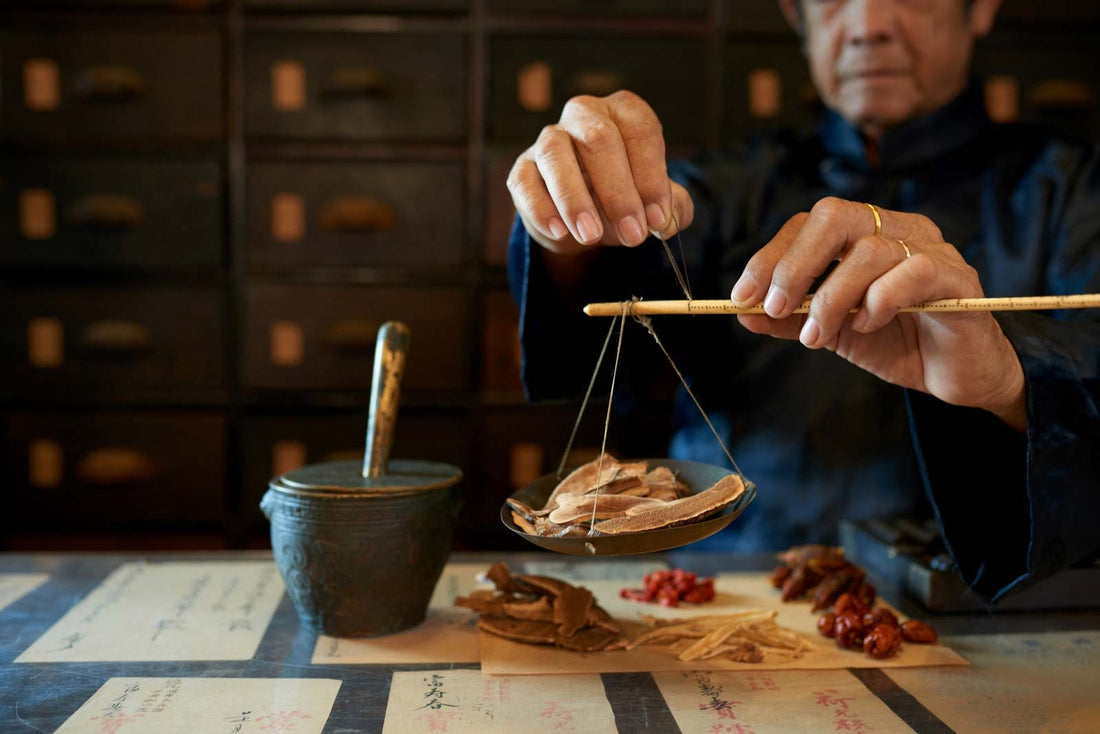
The Apothecary
Traditional Chinese Medicine
Traditional Chinese Medicine (TCM) offers a holistic framework for understanding how prolonged or intense emotions can affect physical health.
Ever notice how a stressful month shows up in your stomach? Or how anger literally makes your face flush hot? Traditional Chinese Medicine noticed too — about two thousand years before we had the term "psychosomatic." TCM maps each emotion to an organ, and whether you take the framework literally or as a useful lens, it describes something most of us have lived: long-term emotional stress eventually shows up in the body.
Not sure which one?
Get a quick product pick
Your match
Need a hand?
Find the right supplement faster
Browse the relevant range or ask our team for a quick recommendation.
Here's a practical introduction to how TCM sees the emotion–organ connection, and what it suggests you actually do about it.
What we'd suggest
- If stress is showing up physically — gut trouble, tight chest, disturbed sleep — don't only treat the body part. Address the stress itself: rest, movement, breathwork, and the herbal support below.
- Explore the ChinaHerb range — traditional formulas matched to specific patterns like irritability, worry or restlessness (link below; come ask us which formula fits your picture).
- Try one mind-body practice for 30 days: tai chi, qi gong or 10 minutes of slow breathing daily. The cheapest medicine in this whole article.
- If emotional distress is severe or persistent, see a professional. TCM is a complement to mental health care, never a replacement.
The seven emotions and their organs
TCM distinguishes seven emotions — joy, anger, anxiety, worry, grief, fear and fright — and links each to an organ system: anger to the liver, joy to the heart, worry to the spleen, anxiety and grief to the lungs, fear and fright to the kidneys. Emotions in normal range are healthy responses to life. It's when they become excessive or prolonged — months of suppressed anger, years of grinding worry — that TCM says they disturb the flow of Qi (vital energy) and begin to affect the related organ.

You already know this in your body
The framework sounds abstract until you notice you've felt all of it:
- Anger sends Qi upward — which is why rage makes your face and eyes go red and hot.
- Fear sends Qi downward — hence the saying about nearly wetting yourself with fright. That's a real physiological response.
- Overthinking stagnates spleen Qi — which is why a mentally brutal work deadline kills your appetite.
- Worry knots the Qi, grief disperses it — the heavy chest of anxiety, the hollowed-out exhaustion after loss.
In TCM the heart governs the mind and registers every emotion first, then passes the effect to the related organ — which is why nearly every language puts emotions in the heart. And the street runs both ways: organ dysfunction can disturb the emotions too, which is why people recovering from a long illness often find themselves short-tempered, flat or tearful. That's not weakness; it's the system rebalancing.
What prolonged emotional strain looks like
When emotions stay excessive for long enough, TCM describes recognisable patterns — and they'll sound familiar:
- Heart disturbance: restlessness, forgetfulness, panic, feeling emotionally out of control.
- Liver Qi stagnation: depression, long sighs, the classic "lump in the throat" feeling, a short fuse — and in women, irregular or painful menstruation and breast tenderness.
- Spleen and stomach involvement: indigestion, poor appetite, bloating, irregular bowels — the stressed-gut picture half of us know intimately.

The TCM toolkit
1. Acupuncture: restoring the flow
Acupuncture targets specific points to move stagnant Qi: Liver 3 (Tai Chong) for anger and irritability, Spleen 6 (San Yin Jiao) for worry and digestion, Heart 7 (Shen Men) for a racing, anxious mind. Regular sessions with a qualified practitioner can shift both the emotional pattern and its physical symptoms.
2. Herbal formulas: treating the pattern, not just the symptom
This is where TCM gets specific — formulas are matched to your particular pattern of imbalance rather than a one-size-fits-all "calming" pill. We stock the full ChinaHerb range — 79 formulas — and honestly, that's too many to choose from alone. Pop into one of our stores or message us and we'll help match a formula to your picture.
3. Food as therapy
- Running hot and angry (liver): cooling greens, dandelion, and Qi-moving citrus.
- Worrying and overthinking (spleen): warm, cooked, nourishing food — soups, stews, whole grains. Cold smoothies are not your friend here.
- Fearful and depleted (kidneys): black beans, walnuts, seaweed.
- Everyone: ease off processed food, sugar and alcohol — TCM and modern nutrition agree completely on this one.
4. Mind-body practice
Qi gong and tai chi are moving meditations that calm the nervous system and — in modern terms — lower cortisol. Ten minutes of slow, controlled breathing does more for a knotted chest than an hour of scrolling. Free, portable, and they work even in the load-shedding dark.
5. The unglamorous foundations
Consistent sleep (TCM says it nourishes the heart and calms the mind — modern science just says yes), regular moderate movement to release pent-up energy, and actually expressing emotions instead of archiving them in your shoulders.
An honest word
TCM offers a rich, time-tested framework, and many people find real relief through acupuncture, herbs and its lifestyle wisdom. But severe anxiety, depression or trauma deserves professional mental health care — the TCM toolkit works best alongside it, not instead of it.
Curious which ChinaHerb formula matches your stress pattern — the irritable kind, the worried kind or the can't-switch-off kind? WhatsApp us and we'll talk you through it.
By One Life Health Consultant
Shop this at One Life Health
-
 CHINAHERB - Relaxed Wanderer - 60 Tablets — A classic formula for the irritable, short-fuse liver-Qi picture described above.
 -
 CHINAHERB - Calm Shen - 60 Tablets — Traditionally used to settle a racing, anxious mind.
 -
 CHINAHERB - Nourish Root Yin - 60 Tablets — For the depleted, run-down pattern that follows long strain.
 -
 CHINAHERB - Smooth Intestine - 60 Tablets — Aimed at the stressed-gut side of things when worry lands in digestion.
 -
 CHINAHERB - Meno Well - 60 Tablets — A formula matched to the hormone-shift patterns of the perimenopause years.
From the apothecary shelf
A few products we'd hand a customer asking for a starting point. Not a paid placement — these are what we actually take, recommend, or keep at the front of the shelf.