


The Apothecary
Collagen Supplements in South Africa: A Buyer's Guide to Comparing Brands, Formats & Price
Collagen supplements are one of the most popular wellness categories in South Africa — but not all products are equal.
Reviewed by the One Life Health consultants — Updated July 2026
Not sure which one?
Get a quick product pick
Your match
Need a hand?
Find the right supplement faster
Browse the relevant range or ask our team for a quick recommendation.
A buyer's guide, not another "what is collagen" post
If you've searched collagen in South Africa, you've probably read the same basic explainer a dozen times — collagen is a structural protein, it declines with age, and so on. What actually helps customers at the counter is a straight answer to the real question: with so many brands, formats and price points on the shelf, how do you pick one without overpaying or ending up with something that's mostly filler?
Marine vs bovine — which to choose
The two most common sources you'll see in South Africa are marine (fish-derived) and bovine (beef-derived) collagen.
- Marine collagen is generally type I, tends to dissolve easily in liquid, and is the better choice if you avoid beef for religious, ethical or dietary reasons. Some people find it slightly more expensive per gram.
- Bovine collagen usually contains a blend of type I and type III, is often more budget-friendly, and works well stirred into coffee, smoothies or oats.
Neither source has been shown to be reliably "better" than the other for general use — the right choice usually comes down to diet, budget and how you plan to use it day to day.
Hydrolysed vs non-hydrolysed
Look for the word "hydrolysed" (or "collagen peptides") on the label. This means the collagen has been broken down into smaller units that dissolve easily and mix into cold or hot liquid without clumping. Non-hydrolysed collagen is harder to work into a daily routine and is far less common on South African shelves for this reason — hydrolysed is the practical default for most people.
How to actually compare price
This is where most shoppers get caught out. A tub that looks cheaper on the shelf price can work out more expensive per serving if the serving size is small or the tub is mostly bulking agents. To compare properly:
- Check the grams of collagen per serving, not just the tub size.
- Divide the price by the total grams of actual collagen in the tub (not the total tub weight) to get a rough price-per-gram.
- Be wary of "proprietary blends" that don't state how much collagen is actually in each scoop.
- Sachets are convenient for travel and consistency but usually cost more per gram than a larger tub — worth it for convenience, not for saving money.
What's added in — and whether it matters
Many collagen products are combined with other ingredients such as vitamin C (which supports the body's own collagen production) or hyaluronic acid (often marketed for skin hydration). These combinations aren't harmful, but they do add cost. If budget is the priority, a plain hydrolysed collagen plus a separate vitamin C source can work out cheaper than a combination product — it's a trade-off between convenience and price, not a right-or-wrong choice.
Powder, capsule or liquid — what suits your routine
Powder is generally the most cost-effective per gram and mixes into coffee, water or food. Capsules are convenient for travel or if you dislike the taste or texture of powder, but you'll typically need several capsules to match the dose in one scoop of powder, which affects the real cost comparison. Liquid shots are the most convenient but usually the most expensive per gram of collagen.
Who tends to use collagen, and what to expect
Most customers who ask me about collagen are looking for general skin and joint support as part of a daily routine, alongside good hydration, protein intake and sun protection. Research suggests collagen supplementation may support skin elasticity and joint comfort over consistent, ongoing use — results build gradually over weeks to months, not overnight, and vary from person to person. Collagen is not a treatment for a diagnosed joint or skin condition; if you have ongoing joint pain or a skin concern that isn't improving, see a doctor.
Precautions
Collagen is generally well tolerated. Check the source (marine, bovine, or occasionally porcine) against any allergies or dietary restrictions before buying. If you're pregnant, breastfeeding, or managing a chronic condition, check with your doctor before starting any new supplement.
Where to buy collagen in South Africa
One Life Health stocks a range of marine and bovine collagen, in powder, capsule and sachet formats, so you can compare price-per-gram and pick what suits your routine. Browse the skin and beauty supplements collection in-store or online at onelife.co.za.
Three good places to start on our shelf:
-
 BARE – Collagen 400g (R681.44) — our best-selling collagen; hydrolysed peptides in a plain powder, the easiest price-per-gram benchmark on the shelf
 -
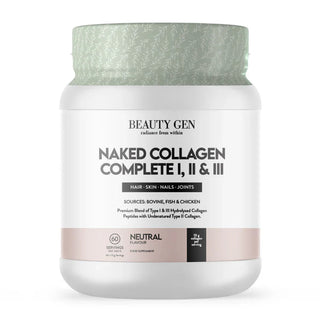
 BEAUTY GEN – Naked Collagen Plus 338g (R449.00) — hydrolysed collagen with added vitamin C, for those who want the cofactor built in
 -
 SONTAL – Peptan Collagen Pure 300g (R480.20) — made with Peptan-branded peptides, the ingredient this guide's comparison section describes
Visit us in-store:
- Centurion (Flagship): 117 Galway Ave, Hennopspark, Centurion, 0157 — 076 913 5059
- Glen Village (Pretoria East): Glen Village Center South, Cnr Solomon Mahlangu Dr & Olympus Dr, Faerie Glen, Pretoria, 0081 — 066 022 7457
- Edenvale (Johannesburg): Shop 7, Green Valley Shopping Centre, Stoneridge Dr, Greenstone Hill, JHB 1609 — 077 356 0173
Free delivery is available nationwide on orders over R400.
Frequently asked questions
Is marine or bovine collagen better?
Neither is reliably better for general use — choose based on dietary preference, budget and how you plan to take it.
How do I compare prices fairly between brands?
Work out the price per gram of actual collagen (price divided by total grams of collagen in the tub, not the tub's total weight), rather than comparing shelf price alone.
Do I need the vitamin C or hyaluronic acid add-ins?
No — they're a convenience, not a requirement. A plain hydrolysed collagen with a separate vitamin C source can be a more affordable route.
How long before I'd notice anything?
Most people who stick with a consistent daily routine start assessing results after 8 to 12 weeks. Collagen isn't a fast-acting product.
Can I take collagen every day long-term?
Many people do use it as an ongoing daily habit. Follow the label's serving guidance, and check in with your doctor if you have any underlying health conditions.
More wellness resources from One Life Health
- Best Probiotics in South Africa (2026 Guide)
- NAD+ & NMN Supplements in South Africa: The Complete Guide (2026)
- Browse all supplements
From the apothecary shelf
A few products we'd hand a customer asking for a starting point. Not a paid placement — these are what we actually take, recommend, or keep at the front of the shelf.