

ESCENTIA
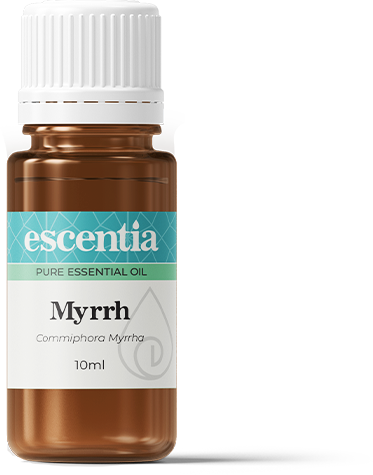
Myrrh Essential Oil 10ml
Myrrh Essential Oil 10mlAll prices include VAT.
Pairs well with
What our consultants add alongside this — and it gets you to free delivery.
Product notice & tag guide
Product tags are a shopping guide only. Always check the product label, ingredients and allergen information before purchase. If you are unsure whether this product is suitable, ask a One Life Health consultant or a qualified healthcare professional. Read our tag guide.
Couldn't load pickup availability
Product details
Escentia’s Myrrh is similar to Frankincense in that it has been used for centuries for spiritual connection and energetic clearing. It is said to be a potent antioxidant. It has long been valued in gargles, toothpaste, dentistry, and as a fixative; it is also used in perfumery for heavy florals and oriental notes.
About Myrrh essential oil:
Myrrh is most commonly known as one of the gifts (along with gold and frankincense) the three wise men brought to Jesus in the New Testament. It was mentioned in the Bible 152 times. In order to harvest myrrh, the tree trunks must be cut into to release the resin. The resin is allowed to dry and begins to look like tears all along the tree trunk. The resin is then collected and the essential oil is made from the sap via steam distillation.
Myrrh oil has a smoky, sweet or sometimes bitter smell. The word myrrh comes from the Arabic word “murr” meaning bitter. The oil is a yellowish, orange color with a viscous consistency. It is commonly used as a base for perfume and other fragrances.
Two primary active compounds are found in myrrh, called terpenoids and sesquiterpenes, both of which have antioxidant properties. Sesquiterpenes are also noted in aromatherapy for their settling, balancing character, helping us feel calm and centred.
Mind: Traditionally reached for where a settling, cooling effect on the emotions is wanted — helpful with apathy and lack of incentive.
Skin: Valued in traditional skin care for its preserving, conditioning qualities, with a cooling character appreciated on dry or chapped skin.
Technique of extraction method:
Myrrh is steam distilled from the crude myrrh. The oleo-gum-resin fills natural fissures in the bark, or exudes as a result of damage caused either by animals chewing the bark, or by deliberate incisions. The crude resin is divided primarily into Heerobol and Bisabol types. The first is reddish-brown and covered with a fine powder, the latter is softer with a deeper yellow colour. The oil can range from pale yellow to greenish or orange-brown. It is fairly thick and becomes sticky with age. It is one of the few essential oils whose fragrance improves with time. It is a warm-spicy, with peculiar pungent balsamic ‘lift’, which mellows to a ‘warmer’ character as the oil ages. It is a base note oil.
Caution:
May affect sensitive skin. Keep out of reach of children. If you are pregnant, nursing, or under a doctor’s care, consult your physician. Avoid contact with eyes, inner ears, and sensitive areas.
Note: We supply Myrrh (Commiphora Myrrha) and Myrrh Wildii from Southern Africa.
Product Specifications: Commiphora Myrrha is often distilled from many species of this shrub, specifically C Longipedicellia, C Terebenthina, C Monoica, C Corrugata and C Africana. They are grown over an arc, from East Africa to Arabia and across to India. A good deal of Myrrh originates in Somalia and Ethiopia. It is a tough shrub, having very spiny branches and twigs. The leaves grow in small tufts and consist of three leaflets up to 2cm long. The flowers have short stalks and are white to light green. They produce a fruit of 1cm in diameter.
Typical Country of Origin:
France
Customer Reviews
Trusted Health, Delivered
25+ years of expert advice · 250+ trusted brands · Free delivery over R400 · 3 Gauteng stores for pickup