

The Apothecary
Black Seed Oil South Africa — Benefits, Price & Where to Buy | One Life Health
Black seed oil (Nigella sativa) has a long history in traditional medicine — and modern research is starting to catch up. From immune support to blood sugar management, its active compound thymoquinone shows genuine promise.
Black Seed Oil in South Africa — What It Is, What to Look For, and Where to Buy
Black seed oil (Nigella sativa) has a long history of traditional use across the Middle East, North Africa and South Asia, and archaeologists have even found seeds of it among the burial goods in Tutankhamun's tomb. That's a genuinely interesting piece of history, and it's why the oil has such a loyal following — but it's history, not a medical claim. Traditional use tells you people have valued something for a very long time; it doesn't tell you what modern research has or hasn't proven. Here's what we can responsibly tell you.
Not sure which one?
Get a quick product pick
Your match
Need a hand?
Find the right supplement faster
Browse the relevant range or ask our team for a quick recommendation.
What is black seed oil?
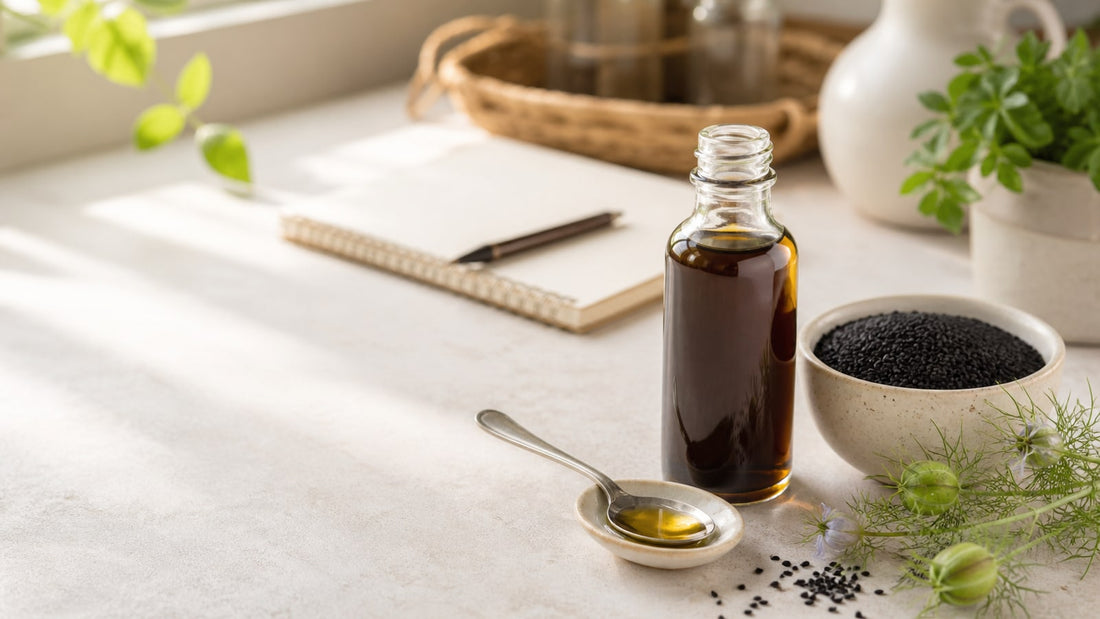
Black seed oil is extracted from the seeds of Nigella sativa, a flowering plant native to Southwest Asia and the Mediterranean. The small, crescent-shaped black seeds have a peppery, slightly bitter flavour and have been used in cooking and traditional remedies for centuries. Good-quality oil is cold-pressed — a method that avoids the heat which can degrade its more delicate compounds.
The seeds contain a range of plant compounds, the best-studied of which is thymoquinone (TQ). Other notable compounds include thymohydroquinone, thymol and carvacrol, alongside essential fatty acids such as linoleic acid (omega-6) and oleic acid (omega-9).
What black seed oil may support
Research on black seed oil and thymoquinone is genuinely active, but much of it is still early-stage — small human trials, animal studies, or laboratory work. We're not going to quote specific study statistics here, because individual trial numbers vary widely and don't always hold up on replication. If you'd like to read the primary literature, search "Nigella sativa thymoquinone" on PubMed.
Immune support
Black seed oil is commonly used as a general immune-support supplement, particularly through the winter months. It's reasonable to include it alongside other immune-support nutrients like vitamin C, zinc and elderberry as part of a broader immunity support routine. It is not a treatment for infections or illness — if you're unwell, especially with a fever or symptoms that persist, please see a doctor rather than relying on any supplement.
Traditional respiratory comfort
Black seed oil has a long traditional history of use for general respiratory comfort. If you have asthma, allergies or any diagnosed respiratory condition, this is not a substitute for your prescribed treatment or inhaler — keep taking your medication exactly as your doctor has directed, and speak to them before adding any supplement.
General antioxidant and metabolic wellness
Thymoquinone is considered one of the oil's main antioxidant compounds, and antioxidant intake is generally understood to be a useful part of a balanced diet. Some people take black seed oil as part of a broader approach to general wellness alongside diet and exercise. It is not a treatment for diabetes, high blood pressure or high cholesterol, and it does not replace prescribed medication for any of these conditions. If you're managing any of them, please continue working with your doctor and don't adjust your medication based on a supplement.
Digestive comfort
Black seed oil is sometimes used for general digestive comfort, and pairs reasonably with a quality probiotic as part of a broader gut health routine. If you have a diagnosed digestive condition, or persistent symptoms like ongoing stomach pain, bloating or changes in bowel habits, that needs proper medical assessment rather than self-treatment with any supplement — please see your doctor.
Skin nourishment
Taken internally or applied topically (patch-test first), black seed oil is used by some people as a general skin-nourishing oil, thanks to its essential fatty acid content. Many customers use it alongside other skin, hair and nail supplements. It is not a treatment for eczema, psoriasis, acne or any other diagnosed skin condition — those need proper diagnosis and care from a doctor or dermatologist.
How to take black seed oil
- Liquid oil (straight): 1–2 teaspoons daily, either on an empty stomach in the morning or with meals. The taste is strong — peppery, slightly bitter, earthy. Some people take it as a "shot" followed by honey or lemon water.
- Mixed into food: drizzle over salads, mix into smoothies, or stir into yoghurt. Avoid cooking with it at high heat, as this can degrade thymoquinone.
- Softgel capsules: a good option if you can't tolerate the taste. Typically 2–4 capsules daily provide roughly the equivalent of 1 teaspoon of liquid oil.
- Topical use: apply a small amount directly to the area of interest. Patch-test first, as some people experience sensitivity.
Timing: many people take it in the morning on an empty stomach; if it causes stomach discomfort, take it with food instead.
General dosage range: most studies have used amounts in the range of 1–3 grams daily (roughly 1–3 teaspoons of oil, or 2–6 standard capsules). Start with a lower amount and increase gradually over a week or two, and always follow the guidance on your specific product's label.
What to look for in a quality product
- Cold-pressed extraction: heat destroys thymoquinone and other delicate compounds. Avoid any oil that doesn't explicitly state it is cold-pressed.
- Source and origin: Ethiopian and Turkish Nigella sativa are traditionally considered high quality; Australian-grown seed is also excellent, benefiting from strict agricultural controls.
- Thymoquinone content: the most useful quality marker. Look for products that declare their thymoquinone percentage. Premium oils typically sit around 1.5–3%.
- Organic or pesticide-free: worth choosing given you're consuming this oil regularly.
- Packaging: black seed oil is sensitive to light and oxidation. Look for dark glass (amber or black) or opaque containers, and avoid clear plastic bottles.
- Capsules vs liquid: capsules are convenient and taste-free; liquid oil is generally more cost-effective per serving. Choose based on preference.
- No fillers: check the ingredient list — a quality product should be 100% Nigella sativa oil.
Black Seed Oil Prices in South Africa (2026)
- Basic cold-pressed oil (250ml): R150–R300
- Quality softgel capsules (90 caps): R150–R250
- HOLISTQ Black Seed Oil (premium, Australian-sourced): R469–R499
Cheaper oils are sometimes extracted using heat or solvents, sourced from lower-thymoquinone seed varieties, or diluted with cheaper carrier oils, which can mean you're paying for something that doesn't match what's on the label. If you're buying black seed oil, it's worth prioritising the sourcing and extraction details above over price alone.
HOLISTQ — available at One Life Health
HOLISTQ is an Australian-sourced, cold-pressed black seed oil available exclusively in South Africa through One Life Health, in 250ml liquid form and 120-capsule softgels.
- Australian-grown Nigella sativa — cultivated under strict agricultural standards, without pesticides or chemical fertilisers
- Cold-pressed extraction — to preserve thymoquinone content
- Independently tested for purity and potency
- Two formats — 250ml liquid oil, or 120 softgel capsules for convenience
- Exclusive to One Life Health in South Africa
It pairs well with other supplements from our herbal supplements range.
Who might consider black seed oil
You might be interested in black seed oil as part of a general wellness routine if you:
- Want general immune support, especially heading into the colder months
- Are looking for a daily source of dietary antioxidants
- Want to add a traditional, food-grade oil to your diet for general wellbeing
- Are already using other skin, gut or immune-support supplements and want to round out the routine
For any diagnosed medical condition — asthma, diabetes, high blood pressure, high cholesterol, eczema, psoriasis, or a digestive disorder — black seed oil is not a treatment, and shouldn't replace your prescribed care. Please talk to your doctor about your specific condition.
Who should avoid or be cautious with black seed oil
- Pregnant and breastfeeding women: there is insufficient safety data. Consult your healthcare provider before use.
- People on blood-thinning medication: black seed oil may enhance anticoagulant effects. Speak to your doctor first.
- People on blood sugar-lowering medication: the combined effect may cause hypoglycaemia. Monitor blood sugar closely and consult your prescribing doctor.
- People scheduled for surgery: discontinue at least two weeks before surgery due to potential blood-thinning effects.
- Those with low blood pressure: black seed oil may further reduce blood pressure.
As with any supplement, discuss new additions to your routine with a qualified healthcare professional, particularly if you have an existing health condition or take prescription medication.
The bottom line
Black seed oil has centuries of traditional use and a genuinely active modern research programme behind it, but the honest answer is that most of that research is still early. Treat it as a general wellness oil worth adding to a balanced diet and routine — not as a treatment for any diagnosed condition. Choose a cold-pressed, well-sourced product, take it consistently, and keep your doctor in the loop about anything you're managing medically.
This article is for educational purposes only and is not medical advice. Black seed oil is not intended to diagnose, treat, cure or prevent any disease. Always talk to your doctor before starting any new supplement, especially if you are pregnant, breastfeeding, on prescription medication, or managing a diagnosed medical condition.
From the apothecary shelf
A few products we'd hand a customer asking for a starting point. Not a paid placement — these are what we actually take, recommend, or keep at the front of the shelf.